
Best Binoculars for Sightseeing.
The best binoculars for sightseeing are lightweight and can be easily carried around. The market today is awash with different kinds of binoculars. Finding the best binoculars can be a daunting task.
This review is to help you choose good binoculars that will help you enjoy sightseeing a little bit more.
Bushnell Legend Ultra HD Roof Prism Binocular

The Bushnell legend ultra HD Roof prism binocular is one of the best binoculars for sightseeing there is! This binocular comes with the ED prime glass and ultra band coatings. This ensures your images are of high quality and most importantly crisp and clear.
This binocular is very lightweight which makes it very easy for you to pack and go for your sightseeing adventure. Bushnell also provides you with a microfibre carry bag and neck strap.
As one of the best binoculars for sightseeing, this binocular comes with a 10x magnification range and a 42mm objective lens. This provides for a wide and clear field of view. This will afford you the luxury of spotting objects quickly with high image clarity.
This binocular is fitted with a RainGuard HD lens coating which is water repellant. It is also a waterproof and fog-proof binocular making it perfect for all weather conditions!
Features
- ED prime glass.
- Waterproof and fog proof.
- HD water repellent lens coating.
- Easily portable.
- Ultra wideband coatings.
- Long eye relief
Nikon 7576 MONARCH 5 8×42

This Nikon Monarch 5 is your go-to binocular for sightseeing. It comes fitted with Extra-low Dispersion (ED) glass lenses which provide high resolution and clear images. The superior resolution also makes images through this binocular become brighter and more natural-looking.
This binocular also comes with a high-eyepoint design. This delivers a clear field of view making your sightseeing adventure fun, even when wearing glasses. There is enough space between the binocular eyecups and your brow.
The fully multi-coated eco-glass lenses help in reducing light loss due to reflection, therefore, ensuring a clearer view. This means you will be able to see images clearly. The dielectric high-reflective prism coating ensures high-contrast images even in low light conditions.
This Nikon binocular comes with a rubber-armored coating for a stronger grip, durability and also protects it from easily slipping off your hands. It is also very lightweight for easier portability making this binocular one of the best binoculars for sightseeing.
Features
- Fully multi-coated eco glass lenses.
- Easily portable.
- Built with dielectric high-reflective prism coating on lenses.
- Waterproof and fog proof.
- ED glass lenses.
- Turn and slide rubber eyecups.
Vortex Optics Razor HD Roof Prism Binoculars

This state-of-the-art binocular is one of the best binoculars for sightseeing there is. The high-end features that come with this binocular qualify their price. They come in different magnification levels ranging from 8×42 to 12×50.
For starters, this binocular is fitted with superior non-reflective lens coatings that ensure the highest brightness levels in low light conditions. The exceptional ED glass combined with dielectric prism coating delivers high definition, clear, bright, color-accurate images.
Constructed with the Armor Tek technology, these binoculars come with scratch-resistant coatings which shield lenses from dirt and scratches. The added rubber armor makes these binoculars very durable.
As one of the best binoculars for sightseeing, these binoculars are lightweight making portability very easy. These binoculars are tripod adaptable to allow you to use them hands-free.
Features
- Fully multi-coated.
- Roof prism for durability.
- Waterproof and fog proof.
- Eyecups that are adjustable.
- Premium ED Glass.
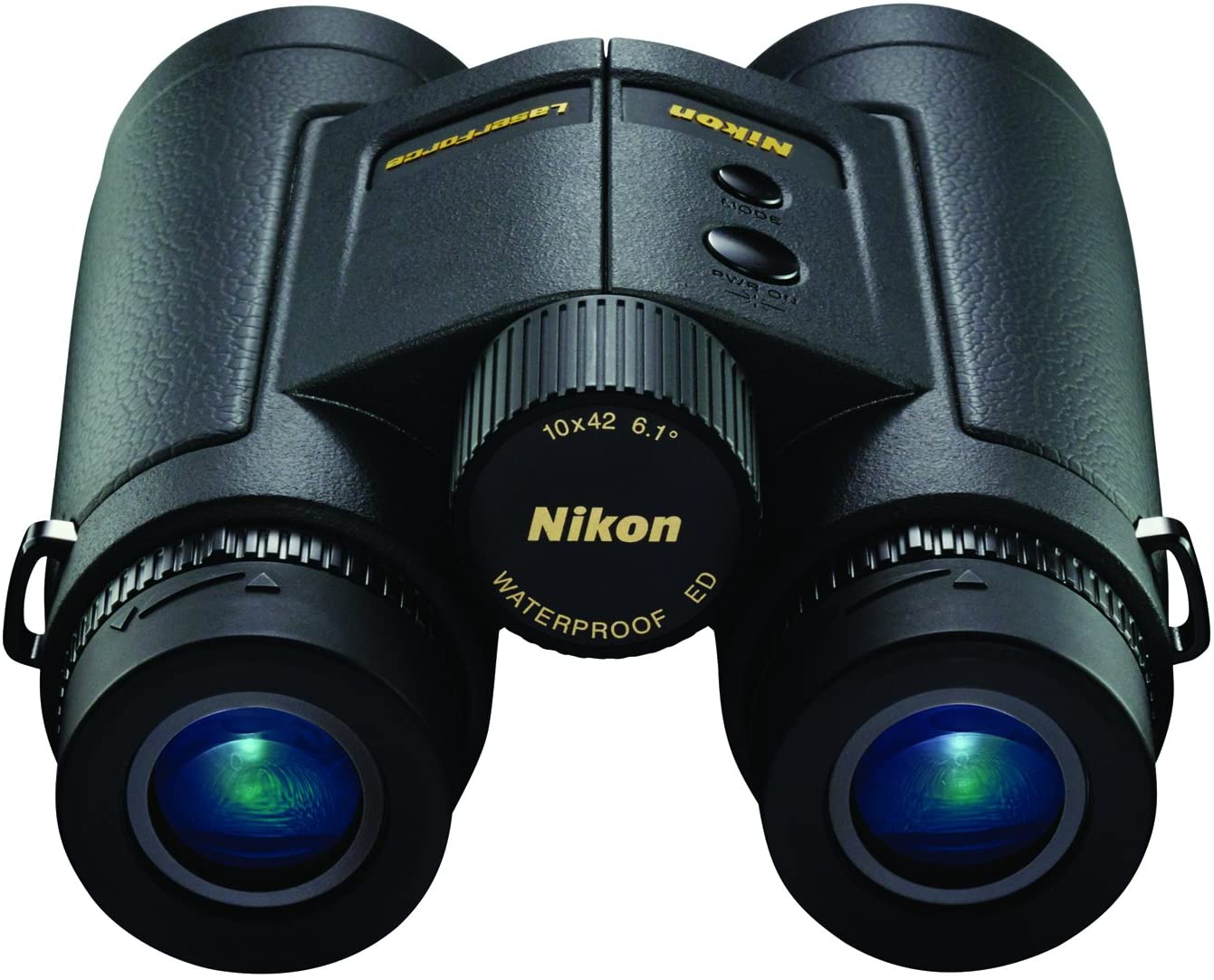
Nikon LASERFORCE RANGEFINDER Binocular

While getting this binocular just to sightsee might be considered overkill, it comes highly recommended especially for spotting animals out in the wild. If you are planning to go for a safari in the African wild, you should definitely consider getting this binocular.
The Nikon laser force rangefinder binocular comes fitted with an in-built rangefinder that allows you to sight objects up to 1,100 yards. A clear field of view is made possible by the long eye relief design.
This Nikon binocular combines fully multilayer-coated lenses with the ED glass to provide high-resolution, high-contrast images.
- Waterproof and fog proof.
- Objective lens caps that can be flipped down to keep the lenses clean.
- Can be used with a tripod.
- Shockproof.
- Has the incline/decline technology.
Bushnell Powerview Wide Angle Binocular

The Bushnell Powerview binocular gets you good performance on a budget. It is built to resist shock and comes with a housing made of ergonomic rubber for a firm grip.
For upgraded light transmission and clarity, this binocular is fitted with fully coated optics. This makes images clearer as you are sightseeing.
The Bushnell Powerview is among the best binoculars for sightseeing because of its robust magnification and wide field of view. The 10x magnification helps you sight objects that are quite far.
Features
- Optics are fully coated.
- Rubber housing to ensure a firm grip.
- Designed beautifully.
Nikon Aculon 10-22×50

This is another budget-friendly binocular you can use for sightseeing. The Nikon aculon 10-22×50 comes equipped with multi-coated lenses that provide high-quality images.
The BaK4 Porro prism enables this binocular to provide images that are of exemplary quality even under unfavorable light conditions. While image brightness is made possible by the presence of multi-coated eco-glass lenses.
As one of the best binoculars for sightseeing, this binocular is made to withstand any environment. With a rubber-armored coating and non-slip grip, this binocular is built to make sightseeing an enjoyable experience.
With all these features, this binocular is still lightweight and easy to carry around all day long.
Features.
- Lightweight.
- Multi-coated lenses.
- Budget-friendly.
- A durable rubber coating.
Athlon Optics Midas Roof Prism UHD Binoculars

This binocular comes with advanced fully multi-coated lenses. This enhances light transmission to bring peak brightness and no color distortion.
The ED glass ensures images are very clear and sharp and because sightseeing is all about seeing images, a multi-layer prism coating that redirects almost 99% of light to your eyes is present. This makes images clearer and has precise color reproduction.
For eyeglass wearers, this binocular has long eye relief for you to see the full field of view. It makes it easy to use even with glasses on.
The Athlon optics is very durable and can easily withstand unfavorable environments.
Features
- Fully multi-coated lenses.
- ED glass
- Long eye relief.
ZEISS VICTORY SF Black Binoculars

There is a lot nature has to offer and you need a piece of equipment to bring the magic closer to your eye. The Zeiss SF is a premium binocular that comes with premium features.
With the price tag, the Zeiss Victory SF comes with a light transmission rate of 92%. This makes it possible for you to go on your sightseeing escapades even in low light conditions. The weight is suitably distributed to ensure its easily portable.
The Zeiss SF is also waterproof and built with durability in mind. It survives in unfavorable conditions. The field of view is wide letting you swiftly locate a target.
Features
- A large field of view.
- LotuTec coating that is water-resistant.
- Waterproof.
- ED fluoride glass.
Factors to consider when choosing the Best Binoculars for Sightseeing.
The best binoculars for sightseeing needs to make distant objects appear closer and clearer.
There are many elements you should consider when picking a binocular:
Magnification
Magnification determines how much closer distant objects appear through the binoculars. For sightseeing, moderate magnification such as 8x or 10x is usually practical because it provides a good balance between bringing distant scenery closer and maintaining a stable view. Very high magnification can make images more difficult to hold steady, especially when viewing moving subjects or using the binoculars without support.
Objective Lens Size
The objective lenses are the larger lenses at the front of the binoculars, and their size affects light gathering and overall dimensions. Larger objective lenses can provide brighter images, particularly in lower light, but they also tend to make binoculars heavier and bulkier. For sightseeing, a medium sized objective lens can provide a useful combination of brightness, portability, and comfort.
Optical Quality
Clear and detailed optics are important when observing landscapes, architecture, wildlife, and other distant sights. Look for binoculars that provide good resolution, accurate colors, strong contrast, and minimal distortion toward the edges of the image. High quality optical construction can make details easier to identify and provide a more enjoyable viewing experience during extended sightseeing sessions.
Field of View
Field of view refers to the width of the area you can see through the binoculars at a particular distance. A wider field of view is useful for sightseeing because it makes it easier to take in large landscapes, city scenes, monuments, and moving subjects. When comparing binoculars, consider both the stated field of view and how easily you can locate your subject after raising the binoculars to your eyes.
Weight and Portability
Sightseeing often involves walking, traveling, and carrying equipment for several hours, so weight should be an important consideration. Lightweight binoculars are easier to carry around and less tiring to hold during extended viewing. Compact designs can also fit more easily into a backpack or travel bag, although extremely small binoculars may involve compromises in brightness and viewing comfort.
Eye Relief and Viewing Comfort
Eye relief describes the distance between your eyes and the eyepieces while still allowing you to see the complete image. Adequate eye relief is particularly important for people who wear glasses because it allows comfortable viewing without having to press the glasses against the eyepieces. Adjustable eyecups can also help users find a comfortable viewing position and reduce eye strain during longer sightseeing sessions.
Build Quality and Weather Resistance
Durable construction is valuable when binoculars are used during travel and outdoor sightseeing. Look for a sturdy body with a comfortable grip and protection against common conditions such as light rain, dust, and accidental bumps. Water resistant or waterproof construction can provide additional protection when sightseeing in unpredictable weather, while a rubberized exterior can make the binoculars easier to handle.
Focusing System
A smooth and responsive focusing system allows you to quickly bring different subjects into sharp view. A central focus wheel is generally convenient for sightseeing because you may move rapidly between nearby and distant objects. Diopter adjustment is also useful because it allows you to compensate for differences between your eyes and achieve a sharper, more comfortable image.
Best Binoculars for Sightseeing FAQs
What magnification is best for sightseeing binoculars?
An 8x magnification is generally a practical choice for sightseeing because it provides a clear, steady view while bringing distant subjects closer. A 10x option can provide more detail at greater distances, but it may be harder to hold steady.
What size binoculars are best for travel and sightseeing?
Compact or mid-sized binoculars are usually convenient for sightseeing because they are easier to carry during walking tours, travel, and outdoor activities. A lightweight design with a moderate objective lens can provide a useful balance between portability and image brightness.
Are waterproof binoculars necessary for sightseeing?
Waterproof or water-resistant binoculars can be beneficial, particularly when sightseeing outdoors or traveling in areas with unpredictable weather. They can help protect the optics from rain and moisture while also providing greater durability for regular travel use
Conclusion
We have outlined the best binoculars for sightseeing that money can buy and we are certain you will find your preferred binos from our review!